skip to main |
skip to sidebar
 Reading Dave Kahle's take on sales perspective this morning I became quite fascinated just how much opinion can shape an organisations stand point without anyone actually even realising. Take this simple story from this mornings papers for example. Three very different takes could lead to a company reacting to the news in 3 very different ways: TAKE 1) The Daily MailFormer BP chief brought in to axe jobs in Whitehall and save taxpayers billions of poundsControversial former BP boss Lord Browne has been parachuted in as the Government's chief Whitehall axeman.This to me is negative. It draws you to the point about jobs being axed and refers to Lord Browne as controversial, immediately raising doubts over the appointment. TAKE 2) The BBCEx-BP boss Lord Browne to lead Whitehall reformFormer BP chief executive Lord Browne has been appointed to oversee moves to make Whitehall "more businesslike".Very neutral, the focus is solely on the appointment and mentions nothing about making cuts or job losses. TAKE 3) Blog KaramelooFormer BP chairman unveiled as ‘cut chief’ to save billions of pounds of taxpayers money in WhitehallThe so-called ‘Sun King’, who was Tony Blair’s favourite businessman, has been asked to use ruthless business methods to save billions of pounds of taxpayers’ money.Very positive overall, reference to 'favourite businessman' gives him some acclaim whilst the story focuses on saving the taxpayer billions of pounds. Again no mention of axing jobs. Imagine if you're tasked with delivering this news within an organisation. Of course, people can think for themselves, but by simply collecting the news from one source, are you getting the full perspective on the story? Because ultimately you're consuming a journalist's opinion. Automating the search means you have the time to view the article from several stand points, analysing in greater detail the implications of the news. It's another advantage to saving hours of daily time hunting down information. With everything delivered to you, it becomes detail to ponder over, rather than detail to find.
 It's no secret that many industry sectors are still plotting ways to get the best out of social media. Whilst many view it as a way of promoting themselves to a big audience the opposite side of the story is it allows the audience direct access to your dressing room after the show (so to speak). Whilst performing in front of millions is one thing, gaining crucial feedback after the set is just as vital. The problem is it's difficult to take all the feedback. Look at the England team for example. Some fans can probably offer some genuine insight into where they went wrong. Most fans would probably just offer some expletives. Sieving through this has always been a problem but imagine the power in the hands of a pharmaceutical company, or a retail giant, if they could get valuable feedback directly from clients without the need to set up workshops or expensive market research projects.With automated media monitoring sieving becomes possible and therefore so does listening to the consumer, as opposed to just yelling things at them from the rooftop. Being able to search quite literally for a needle in a haystack without any of the manual work is quite simply a priceless tool. Imagine the power of spotting a few complaints of side affects after taking a drug, early after release, or finding out a crucial component of the product you sell doesn't seem to work, before losing millions on the production line. So, as a platform for exposing your company, yes, social media is powerful. But as a platform to listen from, and to put yourself in direct contact with the consumer, social media is invaluable.
 from shoutdaily.comA recent debate on Linkedin saw 147 responses to the question 'what is the number 1 critical mistake sales people make in the sales process?' 30% of respondents claimed 'lack of listening caused by too much talking' was the issue. This is a fairly understandable issue as the natural instinct when faced with a high pressured meeting is to defend your product and promote the positives. But let's be honest here, the customer doesn't care about your product. The customer cares about solving the problem they have. That's their number one priority. It doesn't matter if it's you that solves the problem, they just want it solved. So going in all guns blazing telling them how wonderful your product is and how well it's benefited others is never really going to impress, because for this particular client, past successes are irrelevant. If you can't deliver on their problem, they're not interested. Which is why using trigger events immediately gives you the upper hand. You've arrived at the meeting knowing roughly what the problem is, where the gap in the organisation lies. It's then up to you to learn more about the issue, gather intelligence as to what the real pain is and adapt your product to suit the need, rather than fit a square peg in a round hole. The number one advantage of your product might not necessarily fix this problem, but another element might just. Entering a meeting with the focus on the customer's trigger event, apposed to your view on your product, instantly puts your mind in the right place to think this through.
 courtsey of stevenvanwelArtesian were celebrating last night after winning the pitching contest at Microsoft's sixth Bizspark European summit. CEO Andrew Yates shared the prize with French social game pioneer Kobojo, who have gone from 0-41 million users in just under two years. Considering the high level of competition it was a terrific success and one which truly highlights the value of Artesian's b2b service. Artesian was one of four UK companies represented at the event and the trip across the channel proved an invaluable experience with interest flying in from all over Europe. As Andrew was quoted as saying 'it's nice to be hot'. A big thanks once again to the Microsoft Bizspark team for hosting the event and giving us the chance to attend.Ironically enough on his return from Paris Andrew was drawn France in the office World Cup sweepstakes. He's now praying for two french success stories in the space of a month!
 Andrew (far right) celebrating victory
 Artesian CEO Andrew Yates represented Artesian Solutions at the 6th Microsoft BizSpark European Summit today alongside other key entrepreneurs in Europe, as well as Silicon Valley star Guy Kawasaki. The event was held to bring business together to actively 'encourage and foster' entrepreneurship. Held in Paris, the day also included speeches from President of Microsoft International Jean-Philippe Courtois and chairman of Microsoft Europe Jan Muehlfeit. The feedback has so far been immense and you can keep up to date with everything @artesians as Andrew responds to any questions outstanding from the summit. Full information from the event can be found here and we'd like to once again thank the Microsoft bizspark programme for having the opportunity to attend. The interest gained from the presentation just shows the exciting market we're working in and if you're interested in learning more about today's speech by all means just send us an email and we can sort out some info.
 I knew I was onto a winner this morning when I saw Dave Kahle blogging about sales' best practises with the title 'Makes good use of the tools provided by the company.' I gleefully rubbed my hands together anticipating a barrage of soundbites promoting sales software and I was not to be disappointed. So here we go, a run down of the blissfully helpful highlights:"Electronic tools like CRM systems help organize the sales call, and provide a way to automate routine tasks.""Mediocre sales people see all these things as encumbrances: More “busy work,” or someone telling them how to do their job, or encroaching accountability. The real issue underneath these excuses is their fear of, and inability to, change in positive ways and become more effective at their jobs. It is just easier to complain and find fault with the latest software tool that the company wants you to use....To accept them (company provided tools) is to give tacit acceptance to the idea that they can and should improve. They would rather hide under the radar screen of accountability."AND, as a final hurrah:"That’s why making good use of the company-provided sales tools is a best practice of the best sales people."
Dave Kahle, you are now my soundbite hero. How about one regarding automated sales intelligence in the cloud?... Or is that pushing it?
 There can sometimes be a lot of pressure on management to ensure users participate in new software trials. It is after all, management who have green lighted the move to trial and therefore their financial responsibility. It is of course in their best interest to get users engaged in the software and adopting the technology.But whilst there are best practises in making sure this happens (constant dialogue, review sessions, updates etc) the software should encourage user interaction by providing a helpful platform that genuinely improves work flow and solves problems previously highlighted by the sales team.It's a mixture of the two that makes an implementation successful. When it comes to automating sales intelligence, we can not make up the news (although I can try and get this site aggregated as much as possible!) but what we can do is show the value of the technology, proving the concepts that would make a sales team want to come back and use the software again and again.
 Anyone got a 50p for the pay and display?If you're one of those poor people who parks their car on the M25 every morning around quarter to 9 then you've probably, almost certainly cast your eye over a big road map at least once in your life desperately looking for another route. You're looking for another route because you are absolutely sick to death of the current solution. In sales terms, if someone could offer you that other route you'd take it (probably hugging whoever could in the process and animatedly shaking your fist at all the other losers still stuck motionless on the M25). If however, by some minor miracle, the famous motorway/car park was somehow able to figure out a way of actually allowing cars to move and flow freely you'd probably be quite happy joining the road each day. You probably wouldn't want to look at other complicated routes, the current solution is working. Knowing when someone is unhappy with something is the ultimate sales trigger. Why sell to someone who doesn't want to be sold to? Filtering down those who do want a new solution not only saves you time but significantly improves the chance of gaining interest and a prospective new client. That said, anyone know a good route round the damn M25?
 Hugh Grant may seem a strange answer but read onI recently got caught up in a bit of a dispute (court date pending) over what makes a trigger event useful and whether or not they could be used successfully both in prospecting and inside business intelligence. When I say a dispute, it's really for dramatic affect, I'm afraid it was all very amicable but nonetheless I've run home to my blog to have my say. Part of the debate centered around whether relying on sales triggers was more or less important than building solid relationships with customers. But see, in my opinion both come hand in hand. Take, for example, the classic social disaster of putting your foot in it. Asking a friend to go see the new romantic comedy at the cinema failing to realize they've had a fairly horrendous break up two days previously. Your relationship is likely to hit a bit of a wall, probably after several expletives are shared. If you had the knowledge of the breakup, you would actively avoid the rom com (despite your desperation to see Huw Grant get Sandra Bullock for the 18th time) and focus on the friend's needs, thus making you look much better in their eyes. This is the same in business. If a bank calls a company after hearing they're set to expand, they probably stand a better chance of matching that companie's need than if they phoned them say, out of the blue, not hearing the news that they'd just received a £500,000 grant. Thus, the relationship between client and company is much stronger, you've met their needs at a crucial time and they appreciate it. So to separate strong customer bonds and sales triggers would be unfair. The sales triggers inside business intelligence is what builds the bond, not compensate for it.
 Last night three chancellors stood in front of a nation and tried to sell themselves and their politics. They didn't do very well. In fact, they pretty much ticked off every possible sales no no, which must have delighted their respective party leaders. One spent much of his time explaining why his product hadn't worked for 13 years, but would do in the future. One chose to gloat about his product non-stop and the other chose to not really mention his product at all, just slate the other two's product. No one addressed the underlying need, no one really listened to what the customer really wanted and no one did anything but answer their own self obsessed questions with scripted one liners that didn't mean a whole lot to anyone. Politicians spend most of their lives trying to sell. Their policies, their views, (their second homes now too probably). Could someone explain then, how they are possibly so damn bad at it? If I'd just been sat in a room listening to those 3 pitches I'd be thinking to myself 'maybe we can go without.'
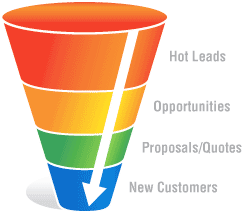 Something that seems to be evolving within our development, is the need to surface different varieties of news at different stages of the sales cycle. Depending on how far down the sales funnel you are, some news takes on more relevance and some takes on much less.For example, at very early stage all you're looking for is away in. If you specialise in marketing for example you're looking for a piece of news that says 'company X holding pitch for campaign' or 'company X ditches marketing agency.' Very straight forward, very specific. However, further down the line, when it comes to the crunch, you want more than that. What might not have been high priority before suddenly takes centre stage. Say their marketing manager has been caught up in a scandal and faces the chop, that could really mess things up from a sales point of view. Say the CEO has decided to reduce budgets across departments, looking to minimize spending in marketing, you need to know (although, probably don't want to...). It's vital to keep on top of goings on with potential customers. If you don't know exactly what's happening, how can you tailor what you're selling accordingly? The simple answer is, you can't.
 If you're sat in the Facebook boardroom today looking on at this graph my guess is you're also smoking a cigar with your feet on the desk smiling very contently. Let's bear in mind here, that the graph above charts the progress within ONE year.Facebook is now the most visited website in the US so it's no wonder people are questioning it's desires to enter the search market. Facebook have been fairly coy on their objectives in this field, largely using the social networking tag as a shield to cover up from competitors glaring eyes. But with figures like the ones above, you'd have to be crazy to not think about dominating more than one market. If Bing thought catching up with Google was going to be tough, they may have a threat coming up sharply on the inside rail that threatens to be even more of a challenge.
 I do try and keep my football addiction away from this blog where possible but like many today I can't help but be struck down by the news that David Beckham is now set to miss the World Cup this summer due to injury. Now you may be thinking 'what has David Beckham possibly got to do a blog that focuses on sales leads and search?' and believe me, I've had to fight long and hard to find a correlation stable enough to let me write about the subject.But the reason why I mention it today is because the incident pretty much sums up the unpredictability of life. Here is a man who was destined to play for his country one last time. He'd fought all the odds, done absolutely everything right and fate seemed to dictate that David Beckham would make it for one last swan song, one last glorious goodbye. The nation expected it, as did the rest of the world. But one stumble on the turf has completely shattered this entire outlook. And more to the point, out of nowhere it has opened the door for somebody else to step in.And I guess that's what my point really. In business terms, just like football it is simply impossible to guess what will happen from day to day. What may seem an impossible cause one day will suddenly become extremely achievable the next. What's bad news for some, could be great news for others. The message here is things can change very quickly and you need to be waiting and ready to pounce when they do. If you're not tracking your market carefully enough, then you'll miss your opportunity, and as Beckham found out yesterday, margins for error can be very small.
 Taken from Sales Intelligence: Preparing for Smarter SellingCRM is proving itself to be an absolute must have in the current market as the above graph shows (I told you I'd try to leave percentages alone. I've moved onto graphs instead). When you consider that the best-in-class companies are achieving quota by a 26% better average than laggards it is clear to see that reducing CRM budget is not an option companies should consider in a bid to cut costs. It has sometimes been assumed that CRM solutions are a 'nice to have' opposed to a 'must have' but that argument no longer stands up. Rather than it being a bonus to know about your customer it really is an absolute necessity as budgets tighten and businesses seek a far more personal experience. There's been a lot of talk about mobile spend increasing, Internet spend increasing, social networking spend increasing, and I can't help but feel that CRM has been largely overlooked in terms of a progressing trend. The solution is there, and the best-in-class are proving that it works.
 It's fantastic to finally have this Aberdeen report, it really is. Spending much of my time fighting the cause for the use of sales intelligence solutions it's great to have some numbers to back up my corner. Of course, I don't want to become one of these people who spends his life talking in percentages but a 26% difference in sales quota success is extremely valuable, especially in these tough economic times. (if you don't know quite what I'm referring to check out this news item)What I find more staggering about the figure though, which is not really covered in the report, is that this vast improvement actually comes from making things 100 times easier. It's not like implementing a sales intelligence solution means having to put in more hours to achieve a better goal. Our automated system, for example, quite literally takes away all of the leg work. Everything comes to the right people without them even having to lift a finger.So, really the figure of a 26% improvement for the best-in-class should also note that that 26% improvement comes by doing things a heck of a lot easier! It's no surprise then, that the report concluded sales cycles for those using such solutions are reducing 5% year-on-year whereas the laggards are seeing a 7% rise. What was I saying about speaking in percentages? Oh yeah, 90% of the time, I'll try harder not too.
 I'm a man of my word and as promised towards the end of last week, The report 'Sales Intelligence: Preparing for Smarter Selling' is now available to download for FREE by using the following link. It's a really great in-depth look at why companies need automated sales intelligence and I believe it really reflects the values and benefits of what Artesian can bring to the table. This week, I'll be blogging opinion and reaction to the report but in the meantime read the ins and outs at your leisure and get back to me with responses and opinions.
Don't want to be going into too much detail on a Friday afternoon but next week will see the Artesian blog focusing on a report conducted by the Aberdeen Group and sponsored by Artesian Solutions titled: Sales Intelligence: Preparing for Smarter Selling.The report focuses on how the use of aggregated business directories and supporting technologies are helping to alleviate the pressure to acquire new and profitable customers, without increasing the cost of identifying and selling to these prospects. There's some really interesting stuff to examine in further detail and you'll be able to download the entire research piece directly from the blog. Any other bloggers wishing to collaborate on this or get extra info on the eye opening bit of research please just get in touch.
 Something that hasn't escaped our notice here at the Artesian hub, is the need for different news at different times during a sales cycle. Potential customers simply can not be placed into one big pen and treated the same. As some creep down the sales funnel ahead of others the importance of relevant news expands. For example, looking for a lead means exactly that. You're looking for something to justify your call, nothing else matters. But if you're on the very brink of closing a deal you want to know everything about that company from management changes to the canteen menu in order to foresee and respond to any potential barriers. With search, it is very hard to section these stages into groups without simply increasing the number of work hours needed to keep track of the diversifying news. Which is why we're working on a far simpler solution which allows customers to track companies through different stages of the process very easily. To steal the wise words of that famous philosopher Tesco, every little helps.
 That's right, today marks the 200th post in Artesian blog history. If you've read all 200 I commend you. 150, pretty good going. Anywhere below 100 and I say to you, where the hell have you been?! You've got some catching up to do. Get reading... Go on, I'll wait.....What better way to celebrate than to see the news this morning that online news is now vastly more popular than print. It is now the third most popular news source in the US, closely behind national and local TV stations. The Pew Research center, who conducted the survey said "News awareness is becoming an anytime, anywhere, any device activity for those who want to stay informed". Couldn't agree with you more!Print is very old hack as far as I'm concerned. It's shelf life is limited, it's structure is dated and anyone who drives a happy thought powered Prius will tell you it's shockingly bad for the environment. So here's to the future. Online news, anytime, anywhere, and at the moments that really matter.
 I often spend my days battling against machines, and unfortunately not in a cool John Connor v Terminator way. No, my battle is more a battle of the mind as apposed to big things exploding in the background whilst I drive off on a Harley spouting witty one liners under my breath. Having software designed to uncover specific triggers in the vast world of the Internet usually puts me into competitive mode. Determined that I can find exactly the same things the software can I'll pit myself in a one V one contest to see who can find relevant material first. In a rather depressing twist, this morning I realised I was in a race I can simply never win. My defeat was confirmed by an innocent looking article in a local paper I was scanning for news. I was put off the story by it's title, it's opening paragraph and the companies involved in the piece (so not a great looking item really). Shortly after I discovered that the automated software had picked the story up. Ready to gloat in it's face triumphantly it was then I realised that right in the middle of the article, completely unrelated to anything proceeding it, was a sales trigger for the particular company in question. Automation is not put off by hunches. It is not distracted by irrelevances. It effortlessly seeks out exactly what it's looking for no matter the circumstance. I hear people say with automation you risk missing things. In fact, it is completely the opposite scenario.


